MythologyMythologyDocumentariesFestivalspersonswarsBeutiful HellasArtFun
Εμφάνιση αναρτήσεων με ετικέτα Wars Of Hellas. Εμφάνιση όλων των αναρτήσεων

2.8.17

Battle of Chaeronea (338 BC)

The Lion of Chaeronea, probably erected by the Thebans in memory of their dead

Battle of Chaeronea, (August 338 BC), battle in Boeotia, central Greece, in which Philip II of Macedonia defeated a coalition of Greek city-states led by Thebes and Athens. The victory, partly credited to Philip’s 18-year-old son Alexander the Great, cemented the Macedonian hegemony in Greece and ended effective military resistance to Philip in the region.

Short briefing
By 338 bce Philip was well into the second decade of his methodical conquest of Greece. The Athenian orator Demosthenes had perceived the threat posed by Macedonian ambitions at a relatively early date, but Philip used diplomacy and the threat of force to isolate Athens and play rival Greek city-states against each other. Thebes, previously a supporter of Philip, was won to the Athenian cause and dispatched troops to supplement the Athenian army and its allies in their efforts to check the Macedonian advance. The Greeks had placed a blocking force at the pass at Thermopylae, so Philip maneuvered his army south toward Boeotia, north of Thebes.
Bust of Philip II of Macedon

Philip led a force of about 30,000 infantry and 2,000 cavalry. The combined Greek host numbered about 35,000 men. Philip placed Alexander, on the left, opposite the Thebans and their elite Sacred Band. The Macedonian phalanx occupied the centre, facing the allied Greek infantry. Philip took positions on the right, across from the Athenians.
Bust of the Athenian politician Demosthenes

There are two dominating interpretations of the events at Chaeronea. The first, firmly established by historian Nicholas G. Hammond in the 1930s and supported by Ian Worthington in the early 21st century, relies on combining the various fragments of ancient texts to provide a complex set of maneuvers used by Philip to secure victory. In that account, Philip drew the inexperienced Athenian militia out of position with a feigned retreat. As the Athenians sought to exploit their perceived advantage, the troops at the Greek centre moved left in an attempt to preserve the line. That opened a gap between the Greek centre and the Thebans, and Alexander, at the head of Philip’s hetairoi (“companion”) cavalry, charged through. The Thebans and allied Greeks were taken from the rear, while the Macedonians routed the Athenians. The second interpretation dismisses many of the later, often anecdotal, ancient texts and instead focuses on the account of Diodorus, which presents a traditional phalanx-on-phalanx battle. In that description, the veteran Macedonians simply overpowered the Greeks, in part because of the Macedonians’ use of the sarissa, a 13- to 21-foot (4- to 6.5-metre) spear that was roughly twice the length of the pikes used by the Greeks.

In both accounts of the battle, the superior discipline of the Sacred Band resulted in its annihilation. Surrounded and unwilling to surrender, the Sacred Band fought nobly, but they were cut down by the Macedonians. Archaeological excavations near the city of Chaeronea (now Khairónia) have uncovered a mound containing the ashes of Macedonian troops, clearly built as a monument to Philip’s victory. In addition, 254 skeletons found buried beneath a funerary marker are believed to be the remains of the Sacred Band, buried in pairs. The battle marked the end of effective military opposition to Philip in Greece and heralded the beginning of Macedonian domination in the region.

DIODORUS SICULUS: THE BATTLE OF CHAERONEA (338 B.C.)

In 338 B.C. the liberty of the old Greek city-states was blasted at Chaeronea in Boeotia by the victory of Philip of Macedon. This battle implied the passing of the Greek system of city-states and the substitution of large military monarchies.

In the year Charondas was first archon in Athens, Philip, King of Macedon, being already in alliance with many of the Greeks, made it his chief business to subdue the Athenians, and thereby with more ease control all Hellas. To this end he presently seized Elateia [a Phocian town commanding the mountain passes southward], in order to fall on the Athenians, imagining to overcome them with ease; since he conceived they were not at all ready for war, having so lately made peace with him. Upon the taking of Elateia, messengers hastened by night to Athens, informing the Athenians that the place was taken, and Philip was leading on his men in full force to invade Attica.

The Athenian magistrates in alarm had the trumpeters sound their warning all night, and the rumor spread with terrifying effect all through the city. At daybreak the people without waiting the usual call of the magistrate rushed to the assembly place. Thither came the officials with the messenger; and when they had announced their business, fear and silence filled the place, and none of the customary speakers had heart to say a word. Although the herald called on everybody "to declare their minds"—as to what was to be done, yet none appeared; the people, therefore, in great terror cast their eyes on Demosthenes, who now arose, and bade them to be courageous, and forthwith to send envoys to Thebes to treat with the Boeotians to join in the defense of the common liberty; for there was no time (he said) to send an embassy for aid elsewhere, since Philip would probably invade Attica within two days, and seeing he must march through Boeotia, the only aid was to be looked for there.

The people approved of his advice, and a decree was voted that such an embassy should be sent. As the most eloquent man for the task, Demosthenes was pitched upon, and forthwith he hastened away [to Thebes. —Despite past hostilities between Athens and Thebes, and the counter-arguments of Philip's envoys, Demosthenes persuaded Thebes and her Boeotian cities that their liberty as well as that of Athens was really at stake, and to join arms with the Athenians.] . . .When Philip could not prevail on the Boeotians to join him, he resolved to fight them both. To this end, after waiting for reinforcements, he invaded Boeotia with about thirty thousand foot and two thousand horse. . . .

Both armies were now ready to engage; they were equal indeed in courage and personal valor, but in numbers and military experience a great advantage lay with the king. For he had fought many battles, gained most of them, and so learned much about war, but the best Athenian generals were now dead, and Chares—the chief of them still remaining—differed but little from a common hoplite in all that pertained to true generalship. About sunrise [at Chaeronea in Boeotia] the two armies arrayed themselves for battle. The king ordered his son Alexander, who had just become of age, yet already was giving clear signs of his martial spirit, to lead one wing, though joined to him were some of the best of his generals. Philip himself, with a picked corps, led the other wing, and arranged the various brigades at such posts as the occasion demanded. The Athenians drew up their army, leaving one part to the Boeotians, and leading the rest themselves.

At length the hosts engaged, and the battle was fierce and bloody. It continued long with fearful slaughter, but victory was uncertain, until Alexander, anxious to give his father proof of his valor—and followed by a courageous band—was the first to break through the main body of the enemy, directly opposing him, slaying many; and bore down all before him—and his men, pressing on closely, cut to pieces the lines of the enemy; and after the ground had been piled with the dead, put the wing resisting him in flight. The king, too, at the head of his corps, fought with no less boldness and fury, that the glory of victory might not be attributed to his son. He forced the enemy resisting him also to give ground, and at length completely routed them, and so was the chief instrument of the victory.

Over one thousand Athenians fell, and two thousand were made prisoners. A great number of Boeotians, too, perished, and many more were captured by the enemy. . .

[After some boastful conduct by the king, thanks to the influence of Demades, an Athenian orator who had been captured], Philip sent ambassadors to Athens and renewed the peace with her [on very tolerable terms, leaving her most of her local liberties]. He also made peace with the Boeotians, but placed a garrison in Thebes. Having thus struck terror into the leading Greek states, he made it his chief effort to be chosen generalissimo of Greece. It being noised abroad that he would make war upon the Persians, on behalf of the Greeks, in order to avenge the impieties committed by them against the Greek gods, he presently won public favor over to his side throughout Greece. He was very liberal and courteous, also, to both private citizens and communities, and proclaimed to the cities that he wished to consult with them as to the common good.' Whereupon a general council [of the Greek cities] was convened at Corinth, where he declared his design of making war on the Persians, and the reasons he hoped for success; and therefore desired the Council to join him as allies in the war. At length he was created general of all Greece, with absolute power, and having made mighty preparations and assigned the contingents to be sent by each city, he returned to Macedonia [where, soon after, he was murdered by Pausanius, a private enemy].

(Diodorus Siculus Libery of History, 26.14)

The Battle of Chaeronea was fought in 338 BC, near the city of Chaeronea in Boeotia, between the Macedonians led by Philip II of Macedon and an alliance of some of the Greek city-states including Athens and Thebes. The battle was the culmination of Philip's campaign in Greece (339–338 BC) and resulted in a decisive victory for the Macedonians.
Spearheadsfrom Theban tomb,Chaeronea

Philip had brought peace to a war-torn Greece in 346 BC, by ending the Third Sacred War, and concluding his ten-year conflict with Athens for supremacy in the north Aegean, by making a separate peace. Philip's much expanded kingdom, powerful army and plentiful resources now made him the de facto leader of Greece. To many of the fiercely independent Greek city-states, Philip's power after 346 BC was perceived as a threat to their liberty, especially in Athens, where the politician Demosthenes led efforts to break away from Philip's influence. In 340 BC Demosthenes convinced the Athenian assembly to sanction action against Philip's territories and to ally with Byzantium, which Philip was besieging. These actions were against the terms of their treaty oaths and amounted to a declaration of war. In summer 339 BC, Philip therefore led his army towards South Greece, prompting the formation of an alliance of a few southern Greek states opposed to him, led by Athens and Thebes.

After several months of stalemate, Philip finally advanced into Boeotia in an attempt to march on Thebes and Athens. Opposing him, and blocking the road near Chaeronea, was the allied Greek army, similar in size and occupying a strong position. Details of the ensuing battle are scarce, but after a long fight the Macedonians crushed both flanks of the allied line, which then dissolved into a rout.
Terracotta flowers from the Macedonian tomb,Chaeronea

The battle has been described as one of the most decisive of the ancient world. The forces of Athens and Thebes were destroyed, and continued resistance was impossible; the war therefore came to an abrupt end. Philip was able to impose a settlement upon Greece, which all states accepted, with the exception of Sparta. The League of Corinth, formed as a result, made all participants allies of Macedon and each other, with Philip as the guarantor of the peace. In turn, Philip was voted as strategos (general) for a pan-Hellenic war against the Persian Empire, which he had long planned. However, before he was able to take charge of the campaign, Philip was assassinated, and the kingdom of Macedon and responsibility for the war with Persia passed instead to his son Alexander.

Background
In the decade following his accession in 359 BC, the Macedonian king, Philip II, had rapidly strengthened and expanded his kingdom into Thrace and Chalkidiki on the northern coast of the Aegean Sea. He was aided in this process by the distraction of Athens and Thebes, the two most powerful city-states in Greece at that point, by events elsewhere. In particular, these events included the Social War between Athens and her erstwhile allies (357–355 BC), and the Third Sacred War which erupted in central Greece in 356 BC between the Phocians and the other members of the Delphic Amphictyonic League. Much of Philip's expansion during this period was at the nominal expense of the Athenians, who considered the north Aegean coast as their sphere of influence, and Philip was at war with Athens from 356–346 BC.

Philip was not originally a belligerent in the Sacred War, but became involved at the request of the Thessalians. Seeing an opportunity to expand his influence into Greece proper, Philip obliged, and in 353 or 352 BC won a decisive victory over the Phocians at the Battle of Crocus Field in Thessaly. In the aftermath, Philip was made archon of Thessaly, which gave him control of the levies and revenues of the Thessalian Confederation, thereby greatly increasing his power. However, Philip did not intervene further in the Sacred War until 346 BC. Early in that year, the Thebans, who had borne the brunt of the Sacred War, together with the Thessalians, asked Philip to assume the "leadership of Greece" and join them in fighting the Phocians. Philip's power was by now so great that ultimately the Phocians did not even attempt to resist, and instead surrendered to him; Philip was thus able to end a particularly bloody war without any further fighting. Philip allowed the Amphictyonic council the formal responsibility of punishing the Phocians, but ensured that the terms were not overly harsh; nevertheless, the Phocians were expelled from the Amphictyonic League, all their cities were destroyed, and they were resettled in villages of no more than fifty houses.
Strygils from Theban tomb,Chaeronea

By 346 BC, the Athenians were war-weary, unable to match Philip's strength, and had begun to contemplate the necessity of making peace. Nevertheless, when it became apparent that Philip would march south that year, the Athenians originally planned to help the Phocians (whom they were allied to) keep Philip out of central Greece, by occupying the pass of Thermopylae, where Philip's superior numbers would be of little benefit. The Athenians had successfully used this tactic to prevent Philip attacking Phocis itself after his victory at Crocus Field. The occupation of Thermopylae was not only for the benefit of Phocis; excluding Philip from central Greece also prevented him from marching on Athens itself. However, by the end of February, the general Phalaikos was restored to power in Phocis, and he refused to allow the Athenians access to Thermopylae. Suddenly unable to guarantee their own security, the Athenians were forced instead into making peace with Philip. Their peace treaty, known as the Peace of Philocrates, made Athens a reluctant ally of Macedon.

For the Athenians, the treaty had been expedient, but it was never popular. Philip's actions in 346 BC had expanded his influence over all Greece, and although he had brought peace, he had come to be seen as the enemy of the traditional liberty of the city-states. The orator and politician Demosthenes had been a principal architect of the Peace of Philocrates, but almost as soon as it was agreed, he wished to be rid of it. Over the next few years, Demosthenes became leader of the "war-party" in Athens, and at every opportunity he sought to undermine the peace. From 343 BC onwards, in order to try to disrupt the peace, Demosthenes and his followers used every expedition and action of Philip to argue that he was breaking the peace. Conversely, there was at first a substantial body of feeling in Athens, led by Aeschines, that the peace, unpopular though it was, should be maintained and developed. Towards the end of the decade however, the "war party" gained the ascendancy, and began to openly goad Philip; in 341 BC for instance, the Athenian general Diopeithes ravaged the territory of Philip's ally Cardia, even though Philip demanded that they desist. Philip's patience finally ran out when the Athenians formed an alliance with Byzantium, which Philip was at that time besieging, and he wrote the Athenians declaring war. Shortly afterward Philip broke off the siege of Byzantium; Cawkwell suggests that Philip had decided to deal with Athens once and for all. Philip went on campaign against the Scythians, and then began to prepare for war in Greece.
Spearheads from the Macedonian tomb,Chaeronea

Prelude
Philip's forthcoming campaign in Greece became linked with a new, fourth, Sacred War. The citizens of Amphissa in Ozolian Locris had begun cultivating land sacred to Apollo on the Crisaean Plain south of Delphi; after some internal bickering the Amphictyonic council decided to declare a sacred war against Amphissa. A Thessalian delegate proposed that Philip should be made leader of the Amphictyonic effort, which therefore gave Philip a pretext to campaign in Greece; it is, however, probable that Philip would have gone ahead with his campaign anyway.
Map showing Philip's movements during 339–338 BC.

At the start of 339 BC, the Thebans had seized the town of Nicaea near Thermopylae, which Philip had garrisoned in 346 BC. Philip does not appear to have treated this as a declaration of war, but it nevertheless presented him with a significant problem, blocking the main route into Greece. However, a second route into central Greece was available, leading over the shoulder of Mount Callidromos and descending into Phocis. However, the Athenians and Thebans had either forgotten the existence of this road, or believed that Philip would not use it; the subsequent failure to guard this road allowed Philip to slip into central Greece unhindered. Philip's relatively lenient treatment of the Phocians at the end of the Third Sacred War in 346 BC now bore fruit. Reaching Elatea, he ordered the city to be re-populated, and during the next few months the whole Phocian Confederation was restored to its former state.This provided Philip with a base in Greece, and new, grateful allies in the Phocians. Philip probably arrived in Phocis in November 339 BC, but the Battle of Chaeronea did not occur until August 338 BC. During this period Philip discharged his responsibility to the Amphicytonic council by settling the situation in Amphissa. He tricked a force of 10,000 mercenaries who were guarding the road from Phocis to Amphissa into abandoning their posts, then took Amphissa and expelled its citizens, turning it over to Delphi. He probably also engaged in diplomatic attempts to avoid further conflict in Greece, although if so, he was unsuccessful.

When news first arrived that Philip was in Elatea, just three days march away, there was panic in Athens. In what Cawkwell describes as his proudest moment, Demosthenes alone counseled against despair, and proposed that the Athenians should seek an alliance with the Thebans; his decree was passed, and he was sent as ambassador. Philip had also sent an embassy to Thebes, requesting that the Thebans join him, or at least allow him to pass through Boeotia unhindered.Since the Thebans were still not formally at war with Philip, they could have avoided the conflict altogether. However, in spite of Philip's proximity, and their traditional enmity with Athens, they chose to ally with the Athenians, in the cause of liberty for Greece. The Athenian army had already pre-emptively been sent in the direction of Boeotia, and was therefore able to join the Thebans within days of the alliance being agreed.

The details of the campaign leading up to Chaeronea are almost completely unknown.Philip was presumably prevented from entering Boeotia by way of Mount Helicon, as the Spartans had done in the run-up to the Battle of Leuctra; or by any of the other mountain passes that led into Boeotia from Phocis. There were certainly some preliminary skirmishes; Demosthenes alludes to a "winter battle" and "battle on the river" in his speeches, but no other details are preserved. Finally, in August 338 BC, Philip's army marched straight down the main road from Phocis to Boeotia, to assault the main allied army defending the road at Chaeronea.
Funerary relief for Athenian footsoldier Pancahres, who probably fell at the battle of Chaeronea.

Opposing forces
According to Diodorus, the Macedonian army numbered roughly 30,000 infantry and 2,000 cavalry, a figure generally accepted by modern historians. Philip took command of the right wing of the Macedonian army and placed his 18-year-old son Alexander (the future conqueror of the Persian Empire) in command of the left wing, accompanied by a group of Philip's experienced generals.

The allied Greek army included contingents from Achaea, Corinth, Chalcis, Epidaurus, Megara and Troezen, with the majority of troops being supplied by Athens and Thebes. The Athenian contingent was led by the generals Chares and Lysicles, and the Thebans by Theagenes. No source provides exact numbers for the Greek army, although Justin suggests that the Greeks were "far superior in number of soldiers"; the modern view is that the numbers of the city states that fought were approximately equal to those of the Macedonians. The Athenians took up positions on the left wing, the Thebans on the right, and the other allies in the centre.

Strategic and tactical considerations
The Greek army had taken up a position near Chaeronea, astride the main road. On the left flank, the Greek line lay across the foothills of Mount Thurion, blocking the side-road that led to Lebedea, while on the right, the line rested against the Kephisos River, near a projecting spur of Mount Aktion.The Greek line, which was about 2.5 miles in length, was thus secure on both flanks. Moreover, the Greek line seems to have slanted north-eastwards across the plain in between, so that it did not face the direction of Macedonian advance full-square. 
Battle-plan of Chaeronea

This prevented Philip from attempting to concentrate his force on the Greek right wing, since the advanced position of the Greek left wing would then threaten Philip's right. Although Philip could attempt to concentrate his force against the Greek left, the troops there occupied high ground, and any attack would be difficult. Since the Greeks could remain on the defensive, having only to prevent Philip's advance, their position was therefore strategically and tactically very strong.

The Battle
According to Plutarch the battle took place on the 7th day of the month of Metageitnion, probably placing it on 2 August or 1 September 338 BC. Philip had over 30,000 men in his army, a big increase on the 10,000 men he could raise early in his reign. The Greeks managed to get close to 30,000 men themselves, but they were made up of a large number of different contingents, not used to fighting together.

The battle was probably fought close to the River Cephisus, on a line running from close to the Macedonian burial mound, south-west to an opening in the hill of Thurium, caused by a stream called Molos. The Macedonians would have had their left flank near the river and been facing east, the Allies their right flank near the river.

Diodorus gives us a very short account of the battle. Philip's son Alexander was given command on one wing, despite his young age (with Philip's most experienced generals for support). Philip was on the other wing at the head of 'picked me' (other sources tell us that Alexander was on the left and Philip on the right). On the allied side the Athenians were on one wing, the Boeotians on the other (again other sources place the Athenians on the Allied left, facing Philip, and the Thebans on the allied right, facing Alexander). The battle itself is described as 'hotly contested for a long time and many fell on both sides, so that for a while the struggle permitted hopes of victory to both'. The key breakthrough came on the Macedonian left, where Alexander, determined to impress his father, broke the solid Theban line. Gaps opened up in the Theban force, and eventually it was put to flight. On the other flank Philip then attacked with his own men, and forced the Athenians to retreat. More than 1,000 Athenians were killed and another 2,000 captured in the battle. Diodorus is much vaguer about the Theban losses, with 'many' killed and 'not a few' captured.

Other sources provide some more details. The Thebans were commanded by Theagenes, the Athenians by Stratocles, Lysicles and Chares. Demosthenes listed Euboea, Achaea, Corinth, Thebes, Megara, Leucadia and Corcyra as Athens's allies. Aeschines added Acarnania to the list.

The battle probably began with a fierce struggle on Alexander's flank, before he was eventually able to force a breakthrough. Philip carried out a feigned retreat on the other flank (see below), before counterattacking at the right moment. The Macedonians then turned on the isolated Greek centre. The Achaean contingent suffered very heavily in this fighting,.

According to Diodorus after the battle Lysicles was tried and condemned to death. Demosthenes was present at the battle, but escaped. Stratocles may have been killed in the battle. Chares doesn't get mentioned in the ancient sources. 

The Theban Sacred Band was wiped out in the battle, and was buried under a stone lion that still survives next to the modern road across the battlefield.

Polyaenus gives two details from the battle, both relating to Philip's flank. The first was that he carried out a shame retreat. The Athenian general Stratocles ordered an attack, shouting 'we will pursue them to the heart of Macedonia'. The retreating Macedonians kept their formation, until the Athenians had come down from their advantageous position. Once the Macedonians had reached higher ground he ordered the retreat to stop, and ordered a counterattack, which the Athenians were unable to resist. The second is that he knew the Athenians were less experienced than his men, and would probably have less stamina, and so deliberately left his main attack until the enemy were tired out. 

The victory was probably due to a combination of Philip's superior leadership, his more modern and more experienced army, and the divided Allied command. One of the best of the Athenian generals, Phocion, was away with the fleet.

Aftermath
In the aftermath of the battle Athens prepared for a siege, but Philip wasn't interested in destroying the city. Instead he wanted to have its support for his planned invasion of Persia, and so he offered generous terms.

According to Diodorus on the evening after the battle he got drunk, and gloated at his captives, until the captured orator Demades shamed him into behaving better. Once Philip settled down, he was able to use Demades to begin peace negotiations with Athens. He then sent Alexander with the Athenian dead, and an offer to return the prisoners for no ransom. This encouraged the Athenians to enter into peace negotiations, which resulted in the Peace of Demades. Athens was left free and independent, with no Macedonian garrison. She was allowed to keep the key islands of Lemnos, Imbros, Delos, Scyros and Samos, and gained Oropus on the Boeotian border. She had to surrender the Chersonese and dissolve what was left of the Athenian league, and agree to become a friend and ally of Macedon. Despite this leniency Demosthenes was still able to lead an anti-Macedonian faction in Athens.

Thebes suffered more harshly. The leaders involved in the decision to change sides were executed or exiled. A new oligarchy of 300 trusted men was placed in charge. She lost all power of the Boeotian league. The Theban prisoners were sold as slaves, and she struggled to get permission to bury her dead. Finally a Macedonian garrison was left in the citadel.

Philip went on to form the League of Corinth, one of the more successful attempts to produce a lasting peace settlement in Greece. His main aim was to use this league to aid his upcoming invasion of Persia, but before he could carry that out he was murdered (336 BC). In the aftermath of his death the settlement of Greece looked to be unravelling, but the young Alexander the Great turned out to be more than capable of restoring the situation. He also proved to be rather less lenient than his father, and in 335 BC, after a failed revolt, he destroyed the city of Thebes. Although the battle of Chaeronea is often said to have marked the end of the liberty of the Greek city states, that is probably better dated to the reign of Alexander the Great, and in particular the reigns of his successors, the 'Diadochi'.

Source/Photography/Bibliography

Διόδωρος Σικελιώτης, Βιβλιοθήκη Ιστορική, 16
Krentz, Peter. Συμβολή στο The Cambridge History of Greek and Roman Warfare - Volume I: Greece, the Hellenistic World and the Rise of Rome (ed. P. Sabin, H. Van Vees, M. Witby), Cambridge University Press, 2007, σ.175. ISBN 978-0-521-78273-9.
Buckler, John (1989). Philip II and the Sacred War. Leiden, The Netherlands: E. J. Brill. ISBN 90-04-09095-9.
Buckley, Terry (1996). Aspects of Greek History, 750–323 BC: A Source-based Approach. London, United Kingdom: Routledge. ISBN 0-415-09957-9.
Cawkwell, George (1978). Philip II of Macedon. London, United Kingdom: Faber & Faber. ISBN 0-571-10958-6.
Davis, Paul K. (1999). 100 Decisive Battles from Ancient Times to the Present: The World’s Major Battles and How They Shaped History. Oxford, United Kingdom: Oxford University Press. ISBN 0-19-514366-3.
Gaebel, Robert E. (2004). Cavalry Operations in the Ancient Greek World. Norman, Oklahoma: University of Oklahoma Press. ISBN 0-8061-3444-5.
Hornblower, Simon (2002). The Greek World, 479–323 BC (Third ed.). London, United Kingdom: Routledge. ISBN 0-415-16326-9.

30.7.17

The Battle Of Yarmouk, 636

It is a common mistake to think of history in terms of battles and wars alone, as if the other events occurring in the world don’t matter. In general, however, the history of ancient times is really a history of constant war. What can define an era, then, is who the wars are against. 

Short briefing
The history of Rome, for example, can be viewed as fundamentally shifting following the defeat of Carthage, when the Roman Republic which had fought against this rival for so long found that it stood alone. In this case, the enemy they turned to fight were themselves, leading to the first (of many) Roman civil wars. A similar shift was about to occur to Byzantium in 636, where one defeated enemy would soon be replaced by another – although in this case, the new enemy would prove to be both external, and far deadlier than the first.
Through the early part of their history, the Byzantines were defined by their war with Persia.  The first conflict between the two took place and the death of the Triumvir Crassus in that battle led directly to the civil war between Pompey and Caesar that would lead to the end of Roman democracy. The last battle between the two came at the conclusion of what scholars refer to as the Last Great War Of Antiquity (at least partially because it _was_ the final Roman/Persian conflict), where they finally defeated the Persian army and stood poised to take over the entire rival empire. Or so they thought.
Yarmouk today.

Far to the south of this conflict stood the Arabian Peninsula, home to innumerable desert tribes. They had not made any major impact on the world up until this point. Although the Romans had once had a province there, it was too far from the centre to hold onto long, and the area was generally beneath the notice of the great empires. Meanwhile, their own disunity and constant intertribal warfare without any outside threats to unite them left them isolated. Until, that is, the arrival of Islam. The new religion gave coherence and unity to the Arab peoples, along with a drive that would see them explode onto the world stage in dramatic fashion.

While the Byzantines had fought the Arabs in some skirmishes and minor battles, their first real engagement was at the Battle of Firaz, a battle in Mesopotamia where a small Byzantine force actually allied with their old enemies, the Persians. The Arab forces under the command of legendary general Khalid ibn al-Walid easily defeated the larger mixed force, through a combination of shrewd maneouvres and exploiting the disunity between the froces on the opposite side. After the Arabs went on to conquer the rest of Persia at the Battle of al-Qādisiyyah, the Emperor Heraclius began to panic. He dispatched the might of the legions to check the seeming inexorable Arab advance. The Byzantines moved south as the Arabs moved west, and the two armies met at the site of the dried-up Yarmouk river.

The Byzantines may still have been Roman Legionnaires at heart, but they bore little resemblances to our traditional view of the Roman warriors. They wore elaborate armour and wielded curved eastern blades, and had even adopted archery, a role previously relegated to units of foreign mercenaries. They were disciplined warriors, and probably thought themselves more than a match for this rabble from the desert. Unfortunately for them, they were facing possibly the greatest military genius of the age. Khalid had studied the Byzantines and used them as a pattern for his own reorganisation of the rag-tag Arab forces into an army that would conquer half the known world. He was about to show the Byzantines just how deadly their own tactics could be.

Khalid knew that the Byzantine army had a larger corp of more experienced officers than his own. He did have a counter to that greater experience however – the Mubarizun. Specially trained duellists, these warriors were used by Khalid to take advantage of the Byzantine and Sassanid tradition of duelling before the battle proper, and the vanity of the Byzantine leaders. One Arab warrior advanced out, dropped his shield and removed his armour, crying out “I am the death of the Pale Faces, I am the killer of Romans, I am the scourge sent upon you, I am Zarrar Ibn al-Azwar!” Several Byzantine officers challenged him, but all perished. He and the other Mubarizun not only left the Byzantines without the leaders they needed for the upcoming battle, but also presumably left the rank and file utterly shitting themselves at the prospect of facing forty thousand of these maniacs.

Despite this, the battle seemed evenly matched, with the Romans gaining an early advantage due to their superior numbers. They even forced an Arab retreat, back to their camp, where the leader of the womanfolk, a formidable lady named Hind who had once led an army against Muhammed, organised the defence that prevented Byzantine victory. The main thing that won the battle for the Arabs, however, was Khalid’s use of his cavalry. By organising them into a mobile guard division, rather than allocating them specific positions, he was able to reinforce key areas, or turn advantages into victory in others. His cavalry also had a major advantage over the Romans as they rode camels, and the Roman horses would go into a panic at the smell of them. On the sixth day, his cavalry managed to rout the Byzantine cavalry entirely, which allowed them to attack the Roman rear, forcing a general retreat. Khalid funnelled them towards a bridge that his forces had secretly captured earlier. The Byzantines  were slaughtered, and the few survivors of the cream of the legions fled the field in disarray.
Byzantium would survive another eight centuries, and remain a major world power for four of those, but the defeat at Yarmouk turned what could have been the dawning of a new age of Roman dominance over the known world into a mere footnote to the rise of a new great power. Persia, rather than becoming part of the Roman Empire, became part of the new Umayyad Caliphate. The Arabs would conquer the whole of the Middle East, the provinces of North Africa that had once been Roman, and even make a good stab at conquering the whole of Europe. The Byzantine Empire had not defeated a rival, but merely replaced them with a new, more inexorable one.

History
In 610, during the Byzantine–Sasanian War of 602–628, Heraclius became the emperor of the Byzantine Empire, after overthrowing Phocas. Meanwhile, the Sasanian Empire conquered Mesopotamia and in 611 they overran Syria and entered Anatolia, occupying Caesarea Mazaca (now Kayseri, Turkey). Heraclius, in 612, managed to expel the Persians from Anatolia, but was decisively defeated in 613 when he launched a major offensive in Syria against the Persians. Over the following decade the Persians were able to conquer Palestine and Egypt. Meanwhile, Heraclius prepared for a counterattack and rebuilt his army. Nine years later in 622, Heraclius finally launched his offensive. After his overwhelming victories over the Persians and their allies in the Caucasus and Armenia, Heraclius, in 627, launched a winter offensive against the Persians in Mesopotamia, winning a decisive victory at the Battle of Nineveh thus threatening the Persian capital city of Ctesiphon. Discredited by these series of disasters, Khosrow II was overthrown and killed in a coup led by his son Kavadh II, who at once sued for peace, agreeing to withdraw from all occupied territories of the Byzantine Empire. Heraclius restored the True Cross to Jerusalem with a majestic ceremony in 629.
Meanwhile, there had been rapid political development in the Arabian Peninsula, where Muhammad had been preaching Islam and by 630, he had successfully united most of the Arabia under a single political authority. When Muhammad died in June 632, Abu Bakr was elected Caliph and his political successor. Troubles emerged soon after Abu Bakr's succession, when several Arab tribes openly revolted against Abu Bakr, who declared war against the rebels. In what became known as the Ridda wars of 632–633, Abu Bakr managed to unite Arabia under the central authority of the Caliph at Medina.
Map detailing the Rashidun Caliphate's invasion of the Levant
Map detailing the Rashidun Caliphate's invasion of the Levant.
Once the rebels had been subdued, Abu Bakr began a war of conquest, beginning with Iraq. Sending his most brilliant general, Khalid ibn al-Walid, Iraq was conquered in a series of successful campaigns against the Sassanid Persians. Abu Bakr's confidence grew, and once Khalid established his stronghold in Iraq, Abu Bakr issued a call to arms for the invasion of Syria in February 634. The Muslim invasion of Syria was a series of carefully planned and well coordinated military operations that employed strategy instead of pure strength to deal with Byzantine defensive measures. The Muslim armies, however soon proved to be too small to handle the Byzantine response, and their commanders called for reinforcements. Khalid was sent by Abu Bakr from Iraq to Syria with reinforcements and to lead the invasion. In July 634, the Byzantines were decisively defeated at Ajnadayn. Damascus fell in September 634, followed by the Battle of Fahl where the last significant garrison of Palestine was defeated and routed.
Caliph Abu Bakr died in 634. His successor, Umar, was determined to continue the Caliphate Empire's expansion deeper into Syria.Though previous campaigns led by Khalid were successful, he was replaced by Abu Ubaidah. Having secured southern Palestine, Muslim forces now advanced up the trade route, where Tiberias and Baalbek fell without much struggle, and conquered Emesa early in 636. From thereon, the Muslims continued their conquest across the Levant.
Byzantine counterattack
Having seized Emesa, the Muslims were just a march away from Aleppo, a Byzantine stronghold, and Antioch, where Heraclius resided. Seriously alarmed by the series of setbacks, Heraclius prepared for a counterattack to reacquire the lost regions. In 635 Yazdegerd III, the Emperor of Persia, sought an alliance with the Byzantine Emperor. Heraclius married off his daughter (according to traditions, his grand daughter) Manyanh to Yazdegerd III, to cement the alliance. While Heraclius prepared for a major offensive in the Levant, Yazdegerd was to mount a simultaneous counterattack in Iraq, in what was meant to be a well-coordinated effort. When Heraclius launched his offensive in May 636, Yazdegerd could not coordinate with the maneuver—probably owing to the exhausted condition of his government—and what would have been a decisive plan missed the mark.
map of Muslim and Byzantine troop movement prior to yarmuk
Muslim and Byzantine Troop Movements before the battle of Yarmouk. Modern countries indicated.
Byzantine preparations began in late 635 and by May 636 Heraclius had a large force concentrated at Antioch in Northern Syria. The assembled Byzantine army contingents consisted of, Slavs, Franks, Georgians, Armenians and Christian Arabs.This force was organized into five armies, the joint leader of which was Theodore Trithyrius. Vahan, an Armenian and the former garrison commander of Emesa, was made the overall field commander, and had under his command a purely Armenian army. Buccinator (Qanatir), a Slavicprince, commanded the Slavs and Jabalah ibn al-Aiham, king of the Ghassanid Arabs, commanded an exclusively Christian Arab force. The remaining contingents, all European, were placed under Gregory and Dairjan. Heraclius himself supervised the operation from Antioch. Byzantine sources mention Niketas, son of the Persian general Shahrbaraz, among the commanders, but it is not certain which army he commanded.
At that time, the Rashidun army was split into four groups: one under Amr in Palestine, one under Shurahbil in Jordan, one under Yazid in the Damascus-Caesarea region and the last one under Abu Ubaidah along with Khalid at Emesa. As the Muslim forces were geographically divided, Heraclius sought to exploit this situation and planned to attack. He did not wish to engage in a single pitched battlebut rather to employ central position and fight the enemy in detail by concentrating large forces against each of the Muslim corps before they could consolidate their troops. By forcing the Muslims to retreat, or by destroying Muslim forces separately, he would fulfill his strategy of recapturing lost territory. Reinforcements were sent to Caesarea under Heraclius' son Constantine III probably to tie down Yazid's forces which were besieging the town. The Byzantine imperial army moved out from Antioch and Northern Syria sometime in the middle of June 636.
The Byzantine imperial army was to operate under the following plan:
  • Jabalah's lightly armed Christian Arabs would march to Emesa from Aleppo via Hama and hold the main Muslim army at Emesa.
  • Dairjan would make a flanking movement—moving between the coast and Aleppo's road—and approach Emesa from the west, striking at the Muslims' left flank while they were being held frontally by Jabalah.
  • Gregory would strike the Muslims' right flank, approaching Emesa from the northeast via Mesopotamia.
  • Qanatir would march along the coastal route and occupy Beirut, from where he was to attack weakly defended Damascus from the west to cut off the main Muslim army at Emesa.
  • Vahan's corps would act as a reserve and would approach Emesa via Hama.
Muslim strategy
The Muslims discovered Heraclius' preparations at Shaizar through Roman prisoners. Alert to the possibility of being caught with separated forces that could be destroyed, Khalid called for a council of war. There he advised Abu Ubaidah to pull the troops back from Palestine and from Northern and Central Syria, and then to concentrate the entire Rashidun army in one place. Abu Ubaidah ordered the concentration of troops in the vast plain near Jabiyah, as control of the area made cavalry charges possible and facilitated the arrival of reinforcements from Umar so that a strong, united force could be fielded against the Byzantine armies. The position also benefited from close proximity to the Rashidun stronghold of Najd, in case of retreat. Instructions were also issued to return the jizya (tribute) to the people who had paid it. However, once concentrated at Jabiyah, the Muslims were subject to raids from pro-Byzantine Ghassanid forces. Encamping in the region was also precarious as a strong Byzantine force was garrisoned in Caeseara and could attack the Muslim rear while they were held in front by the Byzantine army. On Khalid's advice the Muslim forces retreated to Dara’ah (or Dara) and Dayr Ayyub, covering the gap between the Yarmouk Gorges and the Harra lava plains, and established a line of camps in the eastern part of the plain of Yarmouk. This was a strong defensive position and these maneuvers pitted the Muslims and Byzantines into a decisive battle, one which the latter had tried to avoid. During these maneuvers, there were no engagements save for a minor skirmish between Khalid's elite light cavalry and the Byzantine advance guard.
Battlefield
Across the ravines lies the battlefield of Yarmouk, this picture taken about 8 miles away, from Jordan.
map detailing the battle field of Yarmouk
Map detailing the location of the area where the battle took place.
The battlefield lies in the western plane of Syrian Hauran, just south-east of the Golan Heights, an upland region currently on the frontier between Israel, Jordan and Syria, east of the Sea of Galilee. The battle was fought on the plain north of Yarmouk River, which was enclosed on its western edges by a deep ravine known as Wadi-ur-Ruqqad. This ravine joins the Yarmouk River, a tributary of the Jordan River, on its south. The stream had very steep banks, ranging from 30 m (98 ft)–200 m (660 ft) in height. On the north is the Jabiyah road and to the east are the Azra hills, although these hills were outside the actual field of battle. Strategically there was only one prominence in the battlefield: a 100 m (330 ft) elevation known as Tel al Jumm'a, and for the Muslim troops concentrated there, the hill gave a good view of the plain of Yarmouk. The ravine on the west of the battlefield was accessible at a few places in 636 AD, and had one main crossing: a Roman bridge (Jisr-ur-Ruqqad) near 'Ain Dhakar Logistically, the Yarmouk plain had enough water supplies and pastures to sustain both armies. The plain was excellent for cavalry maneuvers.
Troop deployment
Most early accounts place the size of the Muslim forces between 24,000 and 40,000 and the number of Byzantine forces between 100,000 and 400,000. Modern estimates for the sizes of the respective armies vary: the vast majority of estimates for the Byzantine army are between 80,000 and 150,000, while other estimates are as low as 15,000 to 20,000.Estimates for the Rashidun armyare between 25,000 and 40,000. Original accounts are mostly from Arab sources, generally agreeing that the Byzantine army and their allies outnumbered the Muslim Arabs by a sizeable margin.The only early Byzantine source is Theophanes, who wrote a century later. Accounts of the battle vary, some stating it lasted a day, others more than a day.
Rashidun army
During a council of war, the command of the Muslim army was transferred to Khalidi[›] by Abu Ubaidah, Commander in Chief of the Muslim army. After taking command, Khalid reorganized the army into 36 infantry regiments and four cavalry regiments, with his cavalry elite, the mobile guard, held in reserve. The army was organized in the Tabi'a formation, a tight, defensive infantry formation.The army was lined up on a front of 12 kilometres (7.5 mi), facing west, with its left flank lying south on the Yarmouk River a mile before the ravines of Wadi al Allan began. The army's right flank was on the Jabiyah road in the north across the heights of Tel al Jumm'a, with substantial gaps between the divisions so that their frontage would match that of the Byzantine battle line at 13 kilometres (8.1 mi). The center of the army was under the command of Abu Ubaidah ibn al-Jarrah (left center) and Shurahbil bin Hasana (right center). The left wing was under the command of Yazid and the right wing was under Amr ibn al-A'as.Center, left and right wings were given cavalry regiments, to be used as a reserve for counter-attack in case they were pushed back by the Byzantines. Behind the center stood the mobile guard under the personal command of Khalid. If and when Khalid was too occupied in leading the general army, Dharar ibn al-Azwar would command the mobile guard. Over the course of the battle, Khalid would repeatedly make critical and decisive use of this mounted reserve. Khalid sent out several scouts to keep the Byzantines under observation.In late July 636, Vahan sent Jabalah with his lightly armored Christian Arab forces to reconnoiter-in-force, but they were repulsed by the mobile guard. After this skirmish, no engagement occurred for a month.
Weaponry
Helmets used included gilded helmets similar to the silver helmets of the Sassanid empire. Mail was commonly used to protect the face, neck and cheeks either as an aventail from the helmet or as a mail coif. Heavy leather sandals as well as Roman-type sandal boots were also typical of the early Muslim soldiers. Armor included hardened leather scale or lamellar armor and mail armor. Infantry soldiers were more heavily armored than horsemen. Large wooden or wickerwork shields were used. Long-shafted spears were used, with infantry spears being 2.5 m (8.2 ft) long and cavalry spears being up to 5.5 m (18 ft) long. Short infantry swords like the Roman gladius and Sassanid long swords were used; long swords were usually carried by horsemen. Swords were hung in baldrics. Bows were about 2 metres (6.6 ft) long when unbraced, similar in size to the famous English longbow. The maximum useful range of the traditional Arabian bow was about 150 m (490 ft). Early Muslim archers, while being infantry archers without the mobility of horseback archer regiments, proved to be very effective in defending against light and unarmored cavalry attacks.
Byzantine army
A few days after the Muslims encamped at the Yarmouk plain, the Byzantine army, preceded by the lightly armed Ghassanids of Jabalah, moved forward and established strongly fortified camps just north of the Wadi-ur-Ruqqad.The right flank of the Byzantine army was at the south end of the plains, near the Yarmouk River and about a mile before the ravines of Wadi al Allan began. The left flank of the Byzantines was at the north, a short distance before the Hills of Jabiyah began, and was relatively exposed. Vahan deployed the Imperial Army facing east, with a front about 13 kilometres (8.1 mi) long, as he was trying to cover the whole area between the Yarmouk gorge in the south and the Roman road to Egypt in the north, and substantial gaps had been left between the Byzantine divisions. The right wing was commanded by Gregory and the left by Qanatir. The center was formed by the army of Dairjan and the Armenian army of Vahan, both under the overall command of Dairjan. The Roman regular heavy cavalry, the cataphract, was distributed equally among the four armies, each army deploying its infantry at the forefront and its cavalry as a reserve in the rear. Vahan deployed Jabalah's Christian Arabs, mounted on horses and camels, as a skirmishing force, screening the main army until its arrival. Early Muslim sources mention that the army of Gregory had used chains to link together its foot-soldiers, who had all taken an oath of death. The chains were in 10-man lengths and were used as a proof of unshakeable courage on the part of the men, who thus displayed their willingness to die where they stood and never retreat. The chains also acted as an insurance against a breakthrough by enemy cavalry. However, modern historians suggest that the Byzantines adopted the Graeco-Roman testudo military formation, in which soldiers would stand shoulder-to-shoulder with shields held high and an arrangement of 10 to 20 men would be completely shielded on all sides from missile fire, each soldier providing cover for an adjoining companion.
Weaponry
The Byzantine cavalry was armed with a long sword, known as the spathion. They would also have had a light wooden lance, known as a kontarion and a bow (toxarion) with forty arrows in a quiver, hung from a saddle or from the belt.Heavy infantry, known as skoutatoi, had a short sword and a short spear. The lightly armed Byzantine troops and the archers carried a small shield, a bow hung from the shoulder across the back and a quiver of arrows. Cavalry armor consisted of a hauberk with a mail coif and a helmet with a pendant, i.e. a throat-guard lined with fabric and having a fringe and cheek piece. Infantry was similarly equipped with a hauberk, a helmet and leg armor. Light lamellar and scale armor was also used.
Tensions in the Byzantine army
Khalid's strategy of withdrawing from the occupied areas and concentrating all of his troops for a decisive battle forced the Byzantines to concentrate their five armies in response. The Byzantines had for centuries avoided engaging in large-scale decisive battles, and the concentration of their forces created logistical strains for which the empire was ill-prepared. Damascus was the closest logistical base, but Mansur, leader of Damascus, could not fully supply the massive Byzantine army that was gathered at the Yarmouk plain. Several clashes were reported with local citizens over supply requisition, as summer was at an end and there was a decline of pasturage. Greek court sources accused Vahan of treason for his disobedience to Heraclius' command not to engage in large-scale battle with Arabs. Given the massing of the Muslim armies at Yarmouk, however, Vahan had little choice but to respond in kind. Relations between the various Byzantine commanders were also fraught with tension. There was a struggle for power between Trithurios and Vahan, Jarajis, and Qanatir (Buccinator). Jabalah, the Christian Arab leader, was largely ignored, to the detriment of the Byzantines given his knowledge of the local terrain. An atmosphere of mistrust thus existed between the Romans, Greeks, Armenians, and Arabs. Longstanding ecclesiastical feuds between the Monophysite and Chalcedonian factions, while of negligible direct impact, certainly inflamed underlying tensions. The effect of these feuds was decreased coordination and planning, one of the reasons for the catastrophic Byzantine defeat.

Battle

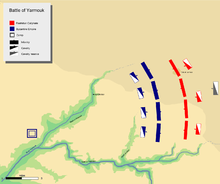
The battle lines of the Muslims and the Byzantines were divided into four sections: the left wing, the left center, the right center and the right wing. Note that the descriptions of the Muslim and the Byzantine battle lines are exactly each other's opposite, i.e.: so the Muslim right wing faced the Byzantine left wing .
map detailing the respective troop deployment before the battle.
Troop deployment.
  Muslim army
  Byzantine army
Vahan was instructed by Heraclius not to engage in battle until all avenues of diplomacy had been explored.[58] This was probably because Yazdegerd III's forces were not yet ready for the offensive in Iraq. Accordingly, Vahan sent Gregory and then Jabalah to negotiate, though their efforts proved futile. Before the battle, on Vahan's invitation, Khalid came to negotiate peace, to a similar end. These negotiations delayed the battles for a month. On the other hand, Caliph Umar, whose forces at Qadisiyah were threatened with confronting the Sassanid armies, ordered Sa`d ibn Abi Waqqas to enter into negotiations with the Persians and send emissaries to Yazdegerd III and his commander Rostam Farrokhzād, apparently inviting them to Islam. This was most probably the delaying tactic employed by Umar on the Persian front. Meanwhile, he sent reinforcements of 6,000 troops, mostly from Yemen, to Khalid. This force included 1,000 Sahaba(companions of Muhammad), among whom were 100 veterans of the Battle of Badr, the first battle in Islamic history, and included citizens of the highest rank, such as Zubayr ibn al-Awwam, Abu Sufyan, and his wife Hind bint Utbah.
Also present were such distinct companions as Sa'id ibn Zayd, Fadl ibn Abbas, Abdul-Rahman ibn Abi Bakr (the son of Abu Bakr), Abdullah ibn Umar (the son of Umar), Aban ibn Uthman (the son of Uthman), Abdulreman ibn Khalid (the son of Khalid), Abdullah ibn Ja'far (the nephew of Ali), Ammar ibn Yasir, Miqdad ibn Aswad, Abu Dharr al-Ghifari, Malik al-Ashtar, Abu Ayyub al-Ansari, Qays ibn Sa'd, Hudhayfah ibn al-Yaman, Ubada ibn as-Samit, Hisham ibn al-A'as, Abu Huraira and Ikrimah ibn Abi Jahl. As this was a citizen army in contrast to a mercenary one, the age of the soldiers ranged from 20 (in the case of Khalid's son) to 70 years old (in the case of Ammar). Three of the ten companions promised paradise by Muhammad, namely Sa'id, Zubayr and Abu Ubaidah, were present at Yarmouk.
Umar, apparently wanting to defeat the Byzantines first, employed the best Muslim troops against them. The continuing stream of Muslim reinforcements worried the Byzantines, who fearing that the Muslims with such reinforcements would grow powerful, decided that they had no choice but to attack. The reinforcements that were sent to the Muslims at Yarmouk arrived in small bands, giving the impression of a continuous stream of reinforcements, in order to demoralize the Byzantines and compel them to attack. The same tactic would be repeated again during the Battle of Qadisiyah.

Day 1

day-1 battle map, showing limited attacks of Byzantine army.
Day 1, limited attacks by the Byzantine army
The battle began on 15 August 636. At dawn both armies lined up for battle less than a mile apart. It is recorded in Muslim chronicles that before the battle started, George, a unit commander in the Byzantine right center, rode up to the Muslim line and converted to Islam; he would die the same day fighting on the Muslim side. The battle began as the Byzantine army sent its champions to duel with the Muslim mubarizun. The mubarizun were specially trained swordsmen and lancers, with the objective to slay as many enemy commanders as possible to damage their morale. At midday, after losing a number of commanders in the duels, Vahan ordered a limited attack with a third of his infantry forces to test the strength and strategy of the Muslim army and, using their overwhelming numerical and weaponry superiority, achieve a breakthrough wherever the Muslim battle line was weak. However the Byzantine assault lacked determination; many soldiers of the Imperial Army were unable to press the attack against the Muslim veterans.The fighting was generally moderate, although in some places it was especially intense. Vahan did not reinforce his forward infantry two-thirds of which was kept in reserve with one-third deployed to engage the Muslims, and at sunset both armies broke contact and returned to their respective camps.

Day 2

day-2 battle map phase 1, showing Byzantine wings pushing back respective Muslim wings.
Day 2, Phase 1.
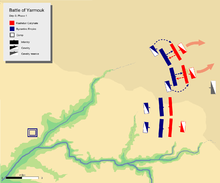
day-2 battle map phase2, showing khalid's flanking attack on Byzantine left flank with his mobile guard.
Day 2, Phase 2.
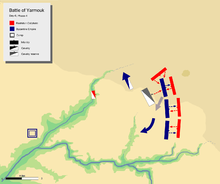
day-2 battle map phase 3, showing khalid's flanking attack on Byzantine right flank with his mobile guard.
Day 2, Phase 3.
Phase 1: On 16 August 636, Vahan decided in a council of war to launch his attack just before dawn, to catch the Muslim force unprepared as they conducted their morning prayers. He planned to engage his two central armies with the Muslim centre in an effort to stall them while the main thrusts would be against the wings of the Muslim army, which would then either be driven away from the battlefield or pushed towards the centre. To observe the battlefield, Vahan had a large pavilion built behind his right wing with an Armenian bodyguard force. He ordered the army to prepare for the surprise attack. Unbeknownst to the Byzantines, Khalid had prepared for such a contingency by placing a strong outpost line in front during the night to counter surprises, which gave the Muslims time to prepare for battle. At the center, the Byzantines did not press hard, intending to pin down the Muslim centre corps in their position and preventing them from aiding the Muslim army in other areas. Thus the center remained stable. But on the wings the situation was different. Qanatir, commanding the Byzantine left flank which consisted of mainly Slavs, attacked in force, and the Muslim infantry on the right flank had to retreat. Amr, the Muslim right wing commander ordered his cavalry regiment to counterattack, which neutralized the Byzantine advance and stabilized the battle line on the right for some time, but the Byzantine numerical superiority caused them to retreat towards the Muslim base camp.
Phase 2: Khalid, aware of the situation at the wings, ordered the cavalry of the right wing to attack the northern flank of the Byzantine left wing while he with his mobile guard attacked the southern flank of the Byzantine left wing, while the Muslim right wing infantry attacked from the front. The three-pronged attack forced the Byzantine left wing to abandon the Muslim positions they had gained on, and Amr regained his lost ground and started reorganizing his corps for another round. The situation on the Muslim left wing which Yazid commanded was considerably more serious. Whilst the Muslim right wing enjoyed assistance from the mobile guard, the left wing did not and the numerical advantage the Byzantines enjoyed caused the Muslim positions to be overrun, with soldiers retreating towards base camps. Here the Byzantines had broken through the corps. The testudo formation that Gregory's army had adopted moved slowly but also had a good defense. Yazid used his cavalry regiment to counterattack but was repulsed. Despite stiff resistance, the warriors of Yazid on the left flank finally fell back to their camps and for a moment Vahan's plan appeared to be succeeding. The centre of the Muslim army was pinned down and its flanks had been pushed back. However, neither flank had broken, though their morale was severely damaged. The retreating Muslim army was met by the ferocious Arab women in the camps. Led by Hind, the Muslim women dismantled their tents and armed with tent poles charged at their husbands and fellow men singing an improvised song from the Battle of Uhud that then had been directed against the Muslims.

O you who run from a constant woman
Who has both beauty and virtue;
And leave her to the infidel,
The hated and evil infidel,
To possess, disgrace and ruin.
This boiled the blood of the retreating Muslims so much that they returned to the battlefield.
Phase 3: After managing to stabilize the position on the right flank, Khalid ordered the mobile guard cavalry to provide relief to the battered left flank. Khalid detached one regiment under Dharar ibn al-Azwar and ordered him to attack the front of the army of Dairjan (left center) in order to create a diversion and threaten the withdrawal of the Byzantine right wing from its advanced position. With the rest of the cavalry reserve he attacked Gregory's flank. Here again, under simultaneous attacks from the front and flanks, the Byzantines fell back, but more slowly because they had to maintain their formation. At sunset the central armies broke contact and withdrew to their original positions and both fronts were restored along the lines occupied in the morning. The death of Dairjan and the failure of Vahan's battle plan left the larger Imperial army relatively demoralized, whereas Khalid's successful counterattacks emboldened his troops despite their being smaller in number.

Day 3

Day 3, Phase 1. showing Byzantine left wing and center pushing back respective Muslim divisions.
Day 3, Phase 1.
Day 3, Phase 2. showing khalid's attack on flank of Byzantine left center with his mobile guard.
Day 3, Phase 2.
On 17 August 636, Vahan pondered over his failures and mistakes of the previous day, where he launched attacks against respective Muslim flanks, but after initial success, his men were pushed back. What bothered him the most was the loss of one of his commanders. The imperial Byzantine army decided on a less ambitious plan, Vahan now aimed to break the Muslim army at specific points. He decided to press upon the relatively exposed right flank, where his mounted troops could maneuver more freely as compared to the rugged terrain at the Muslims' left flank. And it was decided to charge at the junction between the Muslim right center and its right wing held by Qanatir's Slavs, to break the two apart and to fight them separately.
Phase 1: The battle resumed with Byzantine attacks on the Muslim right flank and right center.After holding off the initial attacks by the Byzantines, the Muslim right wing fell back, followed by the right center. They were again said to have been met by their own womenfolk who abused and shamed them. The corps, however, managed to reorganize some distance from the camp and held their ground preparing for a counterattack.
Phase 2: Knowing that the Byzantine army was focusing on the Muslim right, Khalid ibn al-Walid launched an attack with his mobile guard, along with the Muslim right flank cavalry. Khalid ibn al-Walid struck at the right flank of the Byzantines left center, and the cavalry reserve of the Muslims right center struck at the Byzantines left center at its left flank. Meanwhile, he ordered the Muslims' right wing cavalry to strike at the left flank of the Byzantines left wing. The combat soon developed into a bloodbath. Many fell on both sides. Khalid's timely flanking attacks again saved the day for Muslims and by dusk the Byzantines had been pushed back to the positions they had at the start of the battle.

Day 4

18 August 636, the fourth day, was to prove decisive.
day 4 phase 1, showing Byzantine left center and wing pushing back respective Muslim divisions.
Day 4, Phase 1.
day 4 phase 2, showing khalid's flanking attack on Byzantine left center with his mobile guard.
Day 4, Phase 2.
Phase 1: Vahan decided to persist with the previous day's war plan as he had been successful in inflicting damage on the Muslim right. Qanatir led two armies of Slavs against the Muslim right wing and right centre with some assistance from the Armenians and Christian Arabs led by Jabalah. The Muslim right wing and right center again fell back.[73] Khalid entered the fray yet again with this mobile guard. He feared a general attack on a broad front which he wouldn't be able to repulse and as a precaution ordered Abu Ubaidah and Yazid on the left centre and the left wings respectively to attack the Byzantine armies at the respective fronts. The attack would result in stalling the Byzantine front and prevent a general advance of the Imperial army.
Phase 2: Khalid divided his mobile guard into two divisions and attacked the flanks of the Byzantine left center, while the infantry of the Muslim right center attacked from front. Under this three-pronged flanking manoeuvre, the Byzantines fell back. Meanwhile, the Muslim right wing renewed its offense with its infantry attacking from the front and the cavalry reserve attacking the northern flank of the Byzantine left wing. As the Byzantine left center retreated under three-pronged attacks of Khalid, the Byzantine left wing, having been exposed at its southern flank, also fell back.
While Khalid and his mobile guard were dealing with the Armenian front throughout the afternoon, the situation on the other end was worsening. Byzantine horse-archers had taken to the field and subjected Abu Ubaidah and Yazid's troops to intense archery preventing them from penetrating their Byzantine lines. Many Muslim soldiers lost their sight to Byzantine arrows on that day, which thereafter became known as the "Day of Lost Eyes".The veteran Abu Sufyan is also believed to have lost an eye that day.The Muslim armies fell back except for one regiment led by Ikrimah bin Abi Jahal, which was on the left of Abu Ubaidah's corps. Ikrimah covered the retreat of the Muslims with his four hundred cavalry by attacking the Byzantine front, while the other armies reorganized themselves to counterattack and regain their lost positions. All of Ikrimah's men were either seriously injured or dead that day. Ikrimah, a childhood friend of Khalid's was mortally wounded and died later in the evening.

Day 5

troop deployment day-5
Deployment of troops on the fifth day. Khalid gathered all his cavalry for a decisive flanking charge.
During the four-day offense of Vahan, his troops had failed to achieve any breakthrough and had suffered heavy casualties, especially during the mobile guard's flanking counterattacks. Early on 19 August 636, the fifth day of the battle, Vahan sent an emissary to the Muslim camp for a truce for the next few days so that fresh negotiations could be held. He supposedly wanted time to reorganize his demoralized troops. But Khalid deemed victory to be in reach and he declined the offer. Up till now, the Muslim army had adopted a largely defensive strategy, but knowing that the Byzantines were apparently no longer eager for battle, Khalid now decided to take the offensive and reorganized his troops accordingly. All the cavalry regiments were grouped together into one powerful mounted force with the mobile guard acting as its core. The total strength of this cavalry group was now about 8,000 mounted warriors, an effective mounted corps for an offensive attack the next day. The rest of the day passed uneventfully. Khalid planned to trap Byzantine troops, cutting off their every route of escape. There were three natural barriers, the three gorges in the battlefield with their steep ravines, Wadi-ur-Ruqqad at west, Wadi al Yarmouk in south and Wadi al Allah in east. The northern route was to be blocked by Muslim cavalry. There were however, some passages across the 200 metres (660 ft) deep ravines of Wadi-ur-Raqqad in west, strategically the most important one was at Ayn al Dhakar, a bridge. Khalid sent Dharar with 500 cavalry at night to secure that bridge. Dharar moved around the northern flank of Byzantines and captured the bridge. This maneuver was to prove decisive the next day.

Day 6

day 6 phase 1, showing khalid's flanking maneuver at Byzantine left flank routing Byzantine left wing and its cavalry units.
Day 6, Phase 1.
day 6 phase 2, showing khalid's two prong attack on Byzantine cavalry, and Muslim right wing flanking attack on Byzantine left center.
Day 6, Phase 2.
day 6 phase 3, showing khalid's cavalry routed Byzantine cavalry off the field and attacking Byzantine left center at its rear.
Day 6, Phase 3.
day 6 last phase, showing general retreat of Byzantine army towards Wadi-ur-Ruqqad.
Day 6, The last phase.
On 20 August 636, the final day of the battle, Khalid put into action a simple but bold plan of attack. With his massed cavalry force he intended to drive the Byzantine cavalry entirely off the battlefield so that the infantry, which formed the bulk of the imperial army, would be left without cavalry support and thus would be exposed when attacked from the flanks and rear. At the same time he planned to push a determined attack to turn the left flank of the Byzantine army and drive them towards the ravine to the west.
Phase 1: Khalid ordered a general attack on the Byzantine front and galloped his cavalry around the left wing of the Byzantines. Part of his cavalry engaged the Byzantine left wing cavalry while the rest of it attacked the rear of the Byzantine left wing infantry. Meanwhile, the Muslim right wing pressed against it from the front. Under this two-pronged attack, the Byzantine left wing fell back and collapsed and fell back to the Byzantine left center, greatly disordering it. The remaining Muslim cavalry then attacked the Byzantine left wing cavalry at the rear while they were held frontally by the other half of the Muslim cavalry, routing them off the battlefield to the north. The Muslim right wing infantry now attacked the Byzantine left center at its left flank while the Muslim right center attacked from front.
Phase 2: Vahan, noticing the huge cavalry maneuver of the Muslims, ordered his cavalry to group together, but was not quick enough; before Vahan could organize his disparate heavy cavalry squadrons, Khalid had wheeled his cavalry back to attack the concentrating Byzantine cavalry squadrons, falling upon them from the front and the flank while they were still moving into formation. The disorganized and disoriented Byzantine heavy cavalry was soon routed and dispersed to the north, leaving the infantry to its fate.
Phase 3: With the Byzantine cavalry completely routed, Khalid turned to the Byzantine left center which already held the two-pronged attack of the Muslim infantry. The Byzantine left center was attacked at its rear by Khalid's cavalry and was finally broken.
The last phase: With the retreat of the Byzantine left center, a general Byzantine retreat started. Khalid took his cavalry north to block the northern route of escape. The Byzantines retreated west towards Wadi-ur-Ruqqad where there was a bridge at Ayn al Dhakar for safe crossing across the deep gorges of the ravines of Wadi-ur-Ruqqad.Dharar had already captured the bridge as part of Khalid's plan the night before. A unit of 500 mounted troops had been sent to block this passageway. In fact, this was the route by which Khalid wanted the Byzantines to retreat all along. The Byzantines were surrounded from all sides now.Some fell into the deep ravines off the steep slopes, others tried to escape in the waters, only to be smashed on the rocks below and again others were killed in their flight. Nevertheless, a large number of the soldiers managed to escape the slaughter. Jonah, the Greek informant of the Rashidun army during the conquest of Damascus, died in this battle. The Muslims took no prisoners in this battle, although they may have captured some during the subsequent pursuit. Theodore Trithurios died on the battlefield, while Niketas managed to escape and reach Emesa. Jabalah ibn al-Ayham also managed to escape and later, for a short time, came to terms with the Muslims, but soon defected to the Byzantine court again.

Aftermath

Immediately after this operation was over, Khalid and his mobile guard moved north to pursue the retreating Byzantine soldiers; he found them near Damascus and attacked. In the ensuing fight Vahan, who had escaped the fate of most of his men at Yarmouk, was killed. Khalid then entered Damascus where he was said to have been welcomed by the local residents, thus recapturing the city.
When news of the disaster reached the Byzantine Emperor Heraclius at Antioch,he was devastated and enraged. He blamed his wrongdoings for the loss, primarily referring to his incestuous marriage to his niece Martina. He would have tried to reconquer the province if he had the resources,but now he had neither the men nor the money to defend the province any more. Instead he retreated to the cathedral of Antioch, where he observed a solemn service of intercession. He summoned a meeting of his advisers at the cathedral and scrutinized the situation. He was told almost unanimously, and accepted the fact, that the defeat was God's decision and a result of the sins of the people of the land, including him. Heraclius took to the sea on a ship to Constantinople in the night. It is said that as his ship set sail, he bade a last farewell to Syria, saying:
Farewell, a long farewell to Syria, my fair province. Thou art an infidel's (enemy's) now. Peace be with you, O Syria—what a beautiful land you will be for the enemy.
Heraclius abandoned Syria with the holy relic of the True Cross which was, along with other relics held at Jerusalem, secretly boarded on ship by Parthia of Jerusalem, just to protect it from the invading Arabs. It is said that the emperor had a fear of water. and a pontoon bridge was made for Heraclius to cross the Bosphorus to Constantinople. After abandoning Syria, the Emperor began to concentrate on his remaining forces for the defence of Anatolia and Egypt instead. Byzantine Armeniafell to the Muslims in 638–39, after which Heraclius created a buffer zone in central Anatolia by ordering all the forts east of Tarsus to be evacuated. In 639–642 Muslims invaded and captured Byzantine Egypt, led by Amr ibn al-A'as—who had commanded the right flank of the Rashidun army at Yarmouk.
Evaluation
The Battle of Yarmouk can be seen as an example in military history where an inferior force manages to overcome a superior force by superior generalship.
The Imperial Byzantine commanders allowed their enemy to have the battlefield of his choosing. Even then they were at no substantial tactical disadvantage.Khalid knew all along that he was up against a force superior in numbers and, until the last day of the battle, he conducted an essentially defensive campaign suited to his relatively limited resources. When he decided to take the offensive and attack on the final day of battle, he did so with a degree of imagination, foresight and courage that none of the Byzantine commanders managed to display. Although he commanded a numerically inferior force and needed all the men he could muster, he nevertheless had the confidence and foresight to dispatch a cavalry regiment the night before his assault to seal off a critical path of the retreat he anticipated for the enemy army.
Because of his leadership at Yarmouk, Khalid ibn al-Walid is considered one of the finest generals in history[9] and his use of mounted warriors throughout the battle showed just how well he understood the potential strengths and weaknesses of his mounted troops. His mobile guard moved quickly from one point to another, always changing the course of events wherever they appeared, and then just as quickly galloping away to change the course of events elsewhere on the field.
Vahan and his Byzantine commanders did not manage to deal with this mounted force and use the sizable advantage of their army effectively.Their own Byzantine cavalry never played a significant role in the battle and were held in static reserve for most of the six days. They never pushed their attacks and even when they obtained what could have been a decisive breakthrough on the fourth day, they were unable to exploit it. There appeared to be a decided lack of resolve among the Imperial commanders, though this may have been caused by difficulties commanding the army because of internal conflict. Moreover, many of the Arab auxiliaries were mere levies, while the Muslim Arab army consisted for a much larger part of veteran troops.
The original strategy of Heraclius, to destroy the Muslim troops in Syria, needed a rapid and quick deployment, but the commanders on the ground never displayed these qualities. Ironically, on the field at Yarmouk, Khalid carried out on a small tactical scale what Heraclius had planned on a grand strategic scale: by rapidly deploying and manoeuvering his forces, Khalid was able to temporarily concentrate sufficient forces at specific locations on the field to defeat the larger Byzantine army in detail. Vahan was never able to make his numerical superiority count, perhaps because of the unfavorable terrain that prevented large-scale deployment. However, at no point did Vahan attempt to concentrate a superior force to achieve a critical breakthrough. Although he was on the offensive 5 days out of the six, his battle line remained remarkably static. This all stands in stark contrast to the very successful offensive plan that Khalid carried out on the final day, when he reorganised virtually all his cavalry and committed them to a grand manoeuvre that won the battle. George F. Nafziger, in his book Islam at war, describes the battle as:


Source/Photography/Bibliography


Al-Baladhuri, Ahmad ibn Yahya (9th century), Kitab Futuh al-Buldan Check date values in: |date= (help)

Al-Waqidi, Abu Abdullah Muhammad Ibn Umar (8th century), Fatuh al Sham (Conquest of Syria) Check date values in: |date= (help)
Chronicle of Fredegar, 658
Dionysius Telmaharensis (774), Chronicle of Pseudo-Dionysius of Tell-Mahre
Ibn Ishaq (750), Sirah Rasul Allah
Ibn Khaldun (1377), Muqaddimah
The Maronite Chronicles, 664
Pseudo-Methodius (691), Apocalypse of Pseudo-Methodius
Muhammad ibn Jarir al-Tabari (915), History of the Prophets and Kings
Theophanes the Confessor (810–815), Chronographia
Thomas the Presbyter (7th century), Chronicle Check date values in: |date= (help)
Fragment on the Arab Conquests, 636

Palmer, Andrew; Brock, Sebastian P; Hoyland, Robert (819), "West-Syrian Chronicle of 819", West-Syrian Chronicles, ISBN 9780853232384

Η ΙΣΤΟΡΙΑ ΤΩΝ ΙΑΜΑΤΙΚΩΝ ΛΟΥΤΡΩΝ ΚΑΙ Η ΜΕΤΕΞΕΛΙΞΗ ΤΟΥΣ ΣΕ SPA

Τα νερά των φυσικών ή ιαματικών πηγών είναι νερά, που πηγάζουν μέσα από πετρώματα και βράχους που βγαίνουν από τα έγκατα της γης. Είναι εμπλ...